President Trump’s visit to China last week will likely go down as a highly significant moment for relations between the two countries, even if there was no ‘victory’ announcement of a breakthrough on the topics of trade and Taiwan. Auspiciously, President Xi’s ‘constructive China-US relationship of strategic stability’ lays the foundation for divided hegemony, where the great powers can assert control over strategically important jurisdictions, while accepting the quid pro quo of reduced influence in others. In the Middle East we have seen how US involvement has drawn criticism from Beijing, but not retaliation. But how workable is such a solution in a region like South America, where they must compete directly for natural resources?
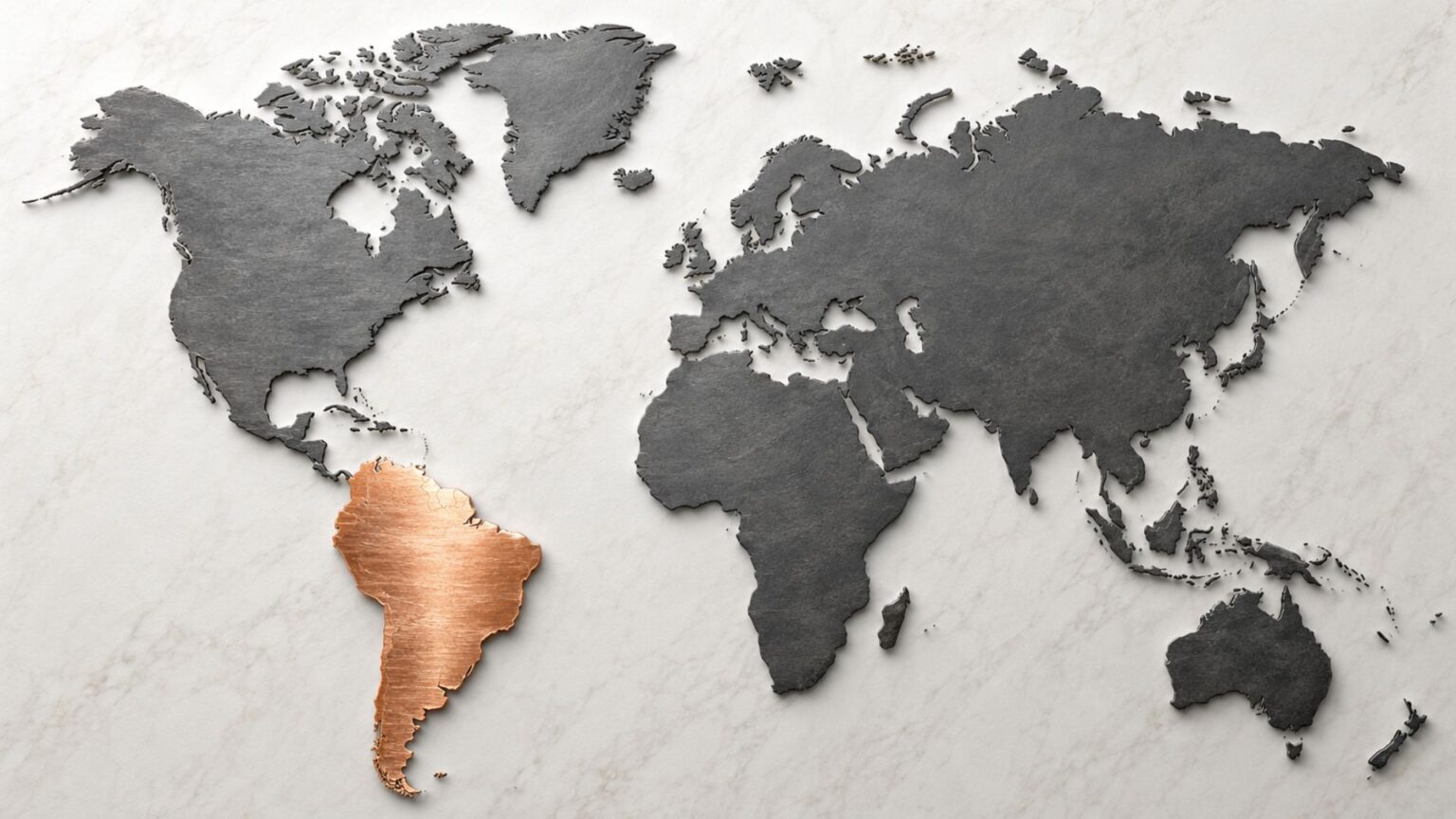
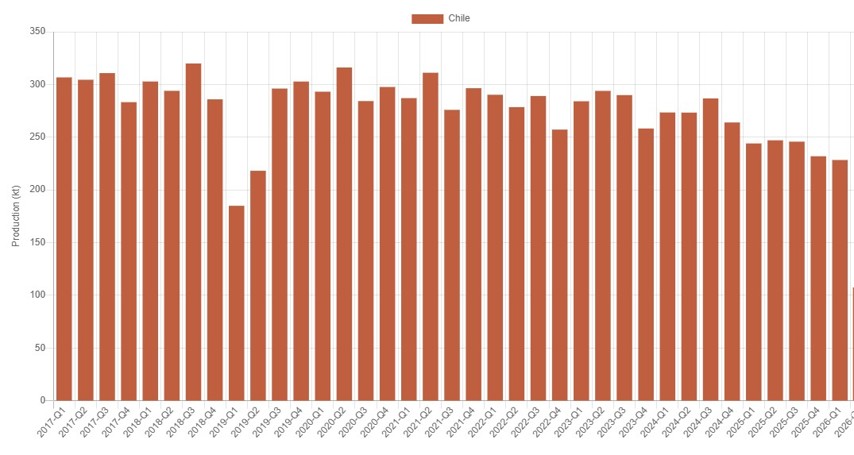
The continent holds over half of the world’s lithium reserves and as much as a third of those for copper, making it a significant player in the critical minerals that are central to the ambitions of both the US and China. So, while there might not have been a significant announcement from the talks in Beijing, there could potentially have been one coming from Santiago. Bechtel, one of the world’s leading engineering, procurement and construction (EPC) firms, headquartered just a forty-five-minute ride west on I66 from the White House, revealed they had signed an agreement with EIMISA ‘to support the delivery of select large-scale mining and infrastructure projects in Chile and across South America’. This should be good news for the smelting industry in the world’s largest producer of mined copper, where SAVANT’s production in beta shows that output has been falling consistently over the last six years (see Chart 1).
Chart 1: SAVANT Copper production in beta, Chile, Q1 2017 – Present
Indeed, ENAMI, the Chilean state-owned national miner, had described financing offers received to build a smelter on the site of the old Hernan Videla Lira (Paipote) site as ‘encouraging’ back in November last year. However, since then progress appears to have stalled. But using foreign-owned EPC contractors to construct big-ticket items, like the expected $1.7 billion facility, opens the door to access funding from the US Export-Import Bank (EXIM), if Bechtel were to be awarded the contract. And in addition, the US could also guarantee an offtake contract for the metal produced by allocating funds from Project Vault. ENAMI would get its smelter/refinery complex, and the US would be able to sure up the deficit in its copper trade balance between domestic demand of ~1.8 Mt/y and current production of only around half that, centred around Rio Tinto’s 320 kt Garfield, Freeport McMoRan’s 225 kt Miami and Grupo Mexico’s 300 kt La Caridad.
Chart 2: SAVANT monitored US primary copper smelters*
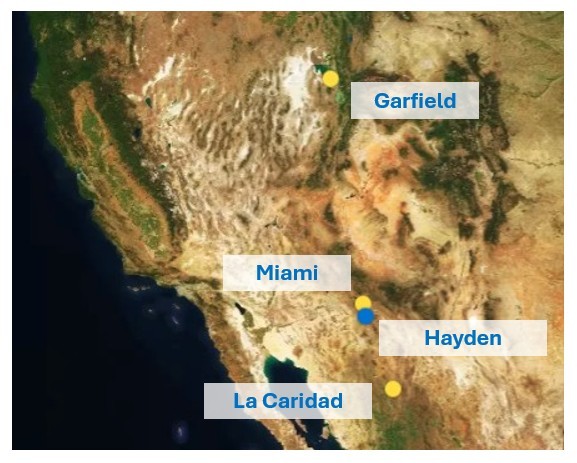
Yellow = active, blue = inactive. * Hayden has been on care and maintenance since 2020.
If resource and processing sovereignty is still the long-term goal for the US with the advancement of projects like behemoth Resolution in Arizona, then at least friendshoring can fill the void in the meantime. Sounds like a win-win, right? … except for one small point – Chile signed a MOU with China to cooperate under the latter’s Belt and Road Initiative (BRI) in November 2018. Since then, The Ribbon Country has been the beneficiary of several major infrastructure projects, including the Kimal-Lo Aguirre high-voltage transmission line, built by a consortium including a subsidiary of China Southern Power Grid. And while smelting powerhouses like Jiangxi Copper and Tongling Non-Ferrous Group have not been publicly linked to any of the offers received by ENAMI, it would seem a logical step for Beijing to want one of its SOEs to participate.
Neither does China’s influence stop there – Peru is also a signatory to BRI, where COSCO Shipping has built the Port of Chancay, as well as the connecting logistics infrastructure to promote it as the hub for South American trade to Asia, particularly in copper exports. But the US government can likewise point to close ties with Peru, boasting a free trade agreement that has been in place since 2009. The Trump administration could be tempted to put some money into the 70 kt La Oroya smelter that has only been operating its zinc processing line since partially reopening in 2024. But with the plant just 200 miles east of Chancay, it would make equally as much sense for Beijing to do so.
Instead, maybe the US government’s interests are better served across the Andes in Brazil, a country that has not signed up to the BRI and where Presidents Trump and Bolsonaro had a close relationship during the former’s first term. Here the perennially challenged 290 kt Camacari complex could be a target for assistance. Due to a lack of profitability, parts of the operation have reportedly been put into ‘hibernation’, including the furnaces. And while the country’s ferronickel smelters would not appear to need any assistance – as SAVANT monitoring shows, 2026 has so far been a good year for production with only a short stoppage for scheduled maintenance at Barro Alto – nickel is a critical mineral in which Brazil has both resources and pedigree.
Chart 3: Brazilian ferronickel smelters, Jan 2026 – Present
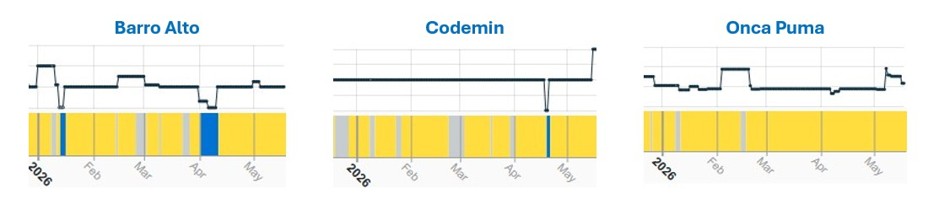
Yellow = active, blue = inactive, grey = no reading
But here again the situation is less clear cut than first meets the eye – in a stance reminiscent of Prime Minster Kwame Nkruma’s doctrine of non-alignment for Ghana during the Cold War, Brazil’s ‘autonomy through diversification’ has already allowed substantial investment from China, especially in telecoms, 5G infrastructure and electricity generation and transmission from no less than the State Grid Corporation of China.
In a South American context President Xi’s ‘constructive relationship’ sounds idealistic and quite possibly guileful. Nearly half of Latin America’s population will go to the polls this year, so there are sure to be winners and losers in presidential races. But the stakes may be even higher for two presidents in the northern hemisphere.