
Our SAVANT Global Metals Monitoring Index indicated that nickel smelting across the globe rose in December 2025, with the percentage of inactive capacity falling by 1.6% to 16.4%. This was despite a collective reduction in operating signals from top producers Indonesia, where the country-level inactive capacity series increased by 0.7% to 16.8%, the highest reading since November 2022.
Simultaneously, active tonnage across the archipelago fell below two million tonnes for the first time since October 2024. With the country in the middle of the rainy season, a number of mining operations on Halmahera in particular have been affected. The island in North Maluku province is home to the behemoth Weda Bay Industrial Park (WBIP) and more than 640 kt/a of nickel capacity under SAVANT observation.
In addition, ore suppliers are reported to be holding back raw material stocks as they await notice from the Ministry of Energy and Mineral Resources (ESDM) of quota allocations for 2026. It was uncertainty surrounding ESDM’s approval of PT Vale Indonesia’s annual production plan that recently prompted the company to announce the suspension of mining activities. To date output at the company’s associated 75 kt/a Sorowako ferronickel smelter in South Sulawesi appears to have been unaffected.
Fig I: SAVANT Indonesia Inactive Capacity Index, August 2025 – Present

Smelting activity increased for all grades of metal, with the inactivity series for Class I nickel falling by 2.9% to just 1.8%, the lowest reading in almost three years. Meanwhile that for nickel pig iron (NPI) fell by 1.2% to 18.5%, primarily due to a strengthened operating profile at Shandong Xinhai’s eponymous 190 kt/a plant that also saw the China country level inactive capacity series fall by 7.3% to 12.9%. Ferronickel brought up the rear with a more modest 0.6% improvement, although with average inactivity across these facilities globally standing at 35.6%, the segment’s structural issues remain.
At a regional level there was no obvious trend, with smelting activity in Asia & Oceania and Europe falling by 1.9% and 0.4% respectively, while the Americas registered an increase of 18%. Africa saw the greatest month-on-month change with a 30.1% rise in inactivity, although volatility on the Mother Continent is greater than in other regions due to the relatively small absolute quantity of smelting capacity at under 100 kt/a.
Fig II: Sorowako smelter, August 2025 – Present
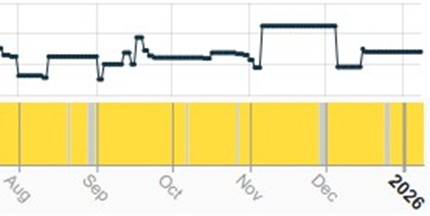
Yellow = active, blue = inactive, grey = no reading