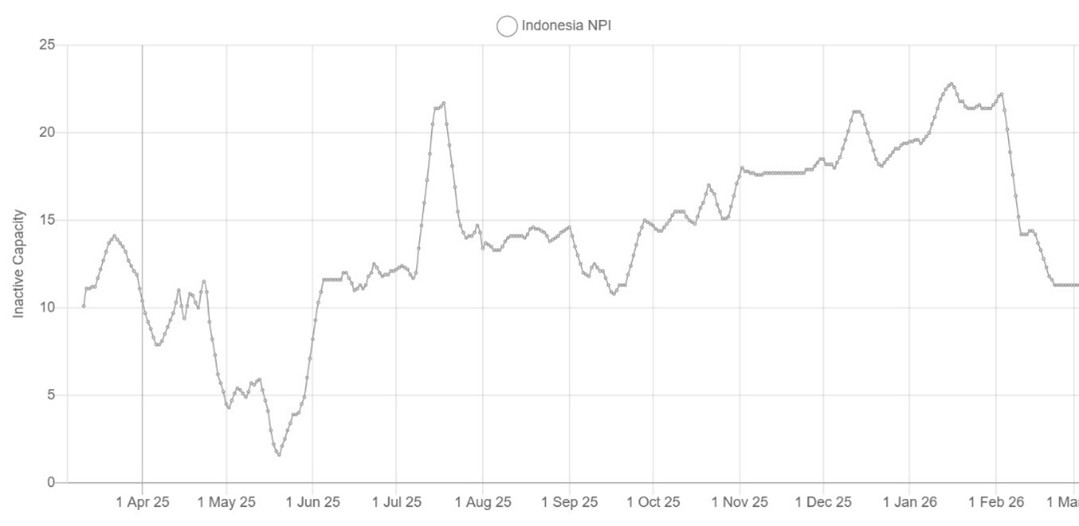
Our March Nickel update demonstrates that global smelting activity rose by 3% in February, resulting in the percentage of the world’s smelting capacity registered as inactive recorded the lowest reading in nine months at 13.9%. This was primarily due to a spike in activity in Indonesia, with the country-level inactive capacity falling by 5.6% to 13.3%.
With the release of quota allocations for 2026 by the Ministry of Energy and Mineral Resources (ESDM) totalling 260 – 270 million tonnes of nickel ore, slightly higher than earlier expectations, operators in the Southeast Asian archipelago appear to have been emboldened to ramp up production to meet the seasonal upswing that comes with the advent of spring in the northern hemisphere. Among those sites that recorded strengthening operating signals were Jindal Stainless’ 28 kt plant in Weda Bay as well as PT Indonesia Huabao’s 72 kt facility in Central Sulawesi.
Fig I: SAVANT Indonesia NPI Inactive Capacity Index, March 2025 – Present
The possibility of a further round of quota applications and approvals before the middle of the year may help sustain this performance, while smelters could also look to supplement domestic raw material feed with increased imports from the Philippines. Production from the pyrometallurgical processing of nickel ores could also be prioritised as companies look to offset falls in output from high-pressure acid leaching (HPAL) facilities, due to the curtailment of sulphur shipments from the Middle East stemming from the war in the region. Sulphur is used to make sulphuric acid which is essential for the leaching of ores in hydrometallurgy.
Meanwhile in China nickel smelting activity remains relatively strong, despite a 0.8% decrease in average activity compared to January. Nevertheless, at 9.8% the country level inactivity series is the second lowest in 18 months and smelting activity is 4% stronger than the 3-year average. Of the other regions, activity strengthened in Europe and Africa by 2.7% and 15.9% respectively, while the Americas registered a decline of 5.8%. Asia & Oceania remains the region with the most active smelters on average, where the inactive capacity sub-index was unchanged at just 6.1%.
With the uptick in smelting in Indonesia, active tonnage for the nickel pig iron (NPI) segment rose to 2.19Mt, the highest reading since June 2025. Simultaneously, activity in both Class I nickel and ferronickel fell, with active tonnage reducing by 11kt and 9kt to 963kt and 306kt respectively.